
Hi there,
What if there were paths to nondual realisation in ancient Europe, and they are hidden in plain sight?
We've all heard of Plato and Socrates, Zeus and Apollo. But according to Dr Athena Potari (recently a Fellow at Harvard's Center for Hellenic Studies) their deeper significance was lost in Europe when Christianity became the only authorised spiritual path.
Her view is that for the ancient Greeks, science and spirituality were not two different things. The mind's way to approach the divinity of the world was called science, the heart's way was called mysticism, and the way of the spirit was philosophy.
So perhaps its no surprise that in 529, non-Christians were barred from teaching any subject, even maths or science, by Emperor Justinian I. The Renaissance excavated Greek mythology as poetry, and science as an investigation that left all matters of spirit to the church. This division continues in modern universities, where philosophy is mostly a contest of ideas rather than a spiritual path.
I found it enriching to revisit myths and terms familiar from childhood through a nondual lens in this recent conversation with Athena.
After a deep enquiry into Eastern approaches, her own awakening, and an impressive academic career (in 2020 Athena received the Academy of Athens Award of Philosophy, and received her PhD from Oxford) Athena is reviving the deeper meaning to be found in Ancient Hellenic culture.
Her school, Athenoa, is a place where Hellenism can be approached as a living wisdom tradition, and an indigenous European path to self-realisation.
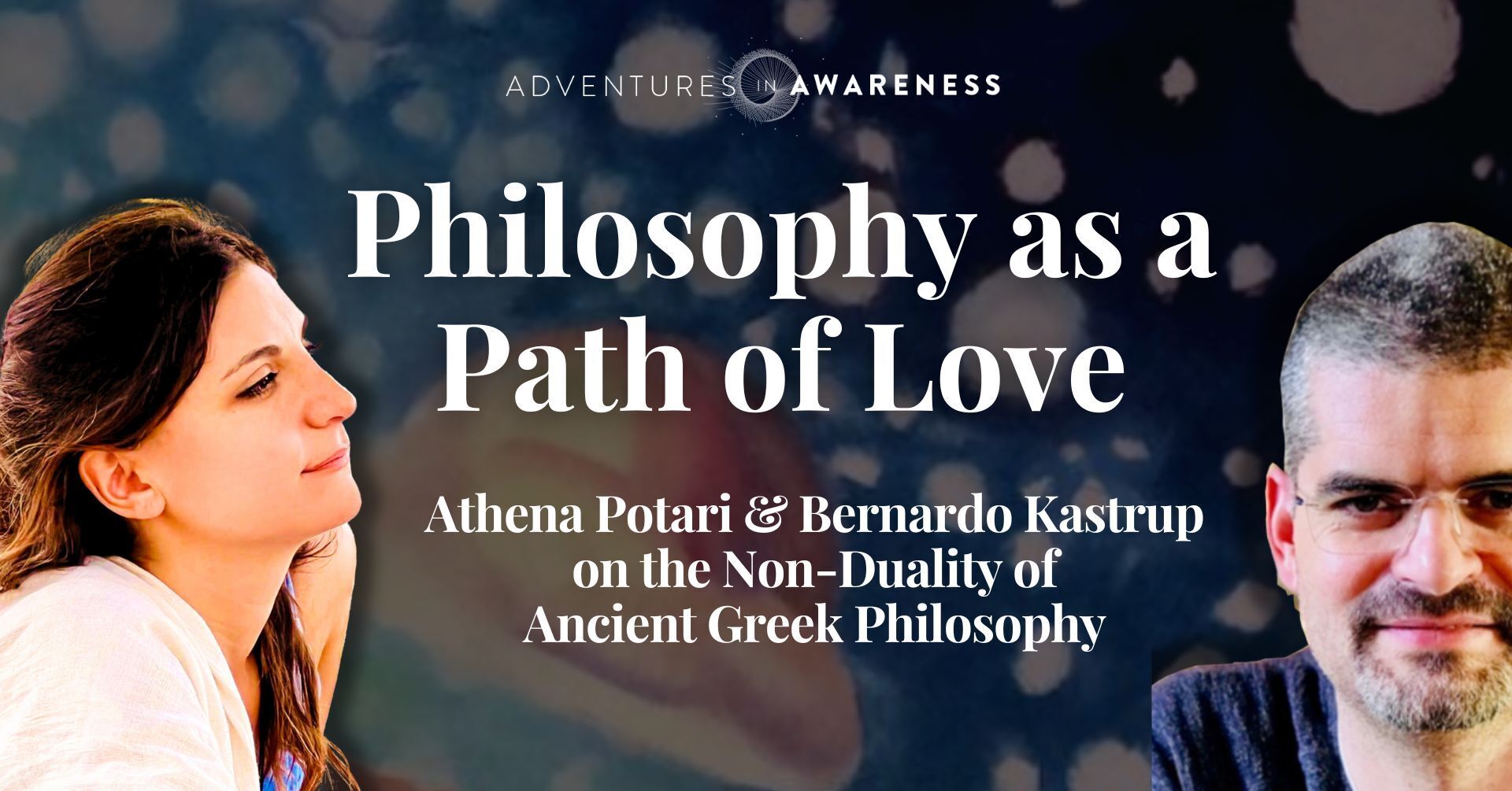
We'll also be hosting a dialogue between Athena and Bernardo Kastrup on the 24th of Feb to compare modern Idealism with Hellenic thought, and how philosophy, properly understood, is a path of love.
Also, happy to say we now have a special mailing list just for London and WhatsApp group just for London, so if that is where you are, you might like to join!
Hope to see you soon!
Amir